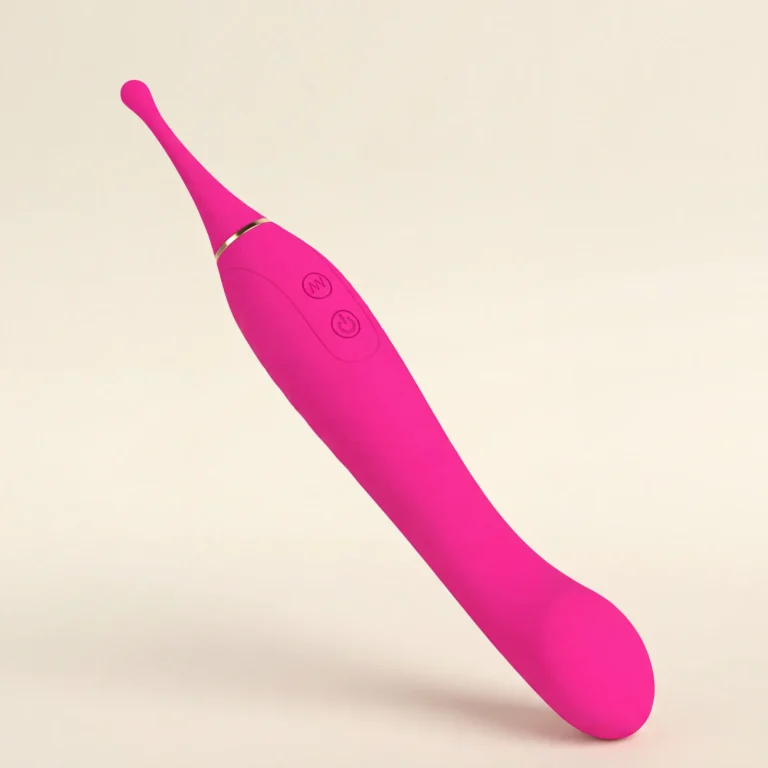
G-Spot Massager or Curved Vibrator: Fit Questions Before Features
Curved intimate-wellness pieces ask a different kind of buying question. Before comparing modes or dramatic features, start with fit, pressure, controls, care, and whether the object feels manageable in your real routine.

Curved intimate-wellness pieces tend to attract confident language.
They are often described by what they can do: more contact, more pressure, more motion, more shape, more features. That can be useful if you already know exactly what you like. It can also make the page harder to read if you are still deciding whether a curved internal piece belongs in your routine at all.
For a first or early purchase, the better question is not “which one has the most modes?”
The better question is: will this shape feel manageable in my real life?
That is the difference between shopping by hype and shopping by fit. A g-spot massager, curved vibrator, or internal massager is not automatically more advanced because it has a curved profile. It simply asks a different set of questions: scale, pressure, controls, care, privacy, and whether you want a more focused external design instead.
This guide is for adults 21+ who want a calmer way to compare curved intimate-wellness pieces before buying.
The Better First Question Is Not “How Many Modes?”
Mode count is easy to market because it looks measurable. Ten patterns sound more impressive than three. A longer feature list can make a product feel more complete. But feature count does not answer the private questions that usually decide whether someone keeps using an intimate-wellness piece after the first week.
The questions are quieter:
- Is the shape easy to understand?
- Does the first setting feel like a beginning, not a jump?
- Can I turn it down or off quickly?
- Will I know how to clean it without worrying?
- Is it discreet enough for my home?
- Does the product page tell me the size, material, charging, care, and privacy details before checkout?
A curved vibrator or g-spot massager should not ask you to perform confidence you do not feel. It should give you enough information to decide whether the form is right for your body, your pace, and your storage reality.
That is why the most useful buying language is often less dramatic than the category usually sounds. Words like fit, pressure, control, surface, scale, cleaning, charging, and storage matter because they are the words that turn an object into a routine.
What A Curved Shape Changes
In broad buyer language, curved internal pieces are built to create a different kind of contact than a straight or purely external piece. Health and sexual-wellness explainers often describe g-spot toys as naturally curved or angled, and general vibrator buying guides usually separate internal, external, and combination designs because each one answers a different preference.
For Lumisyla’s purposes, the practical takeaway is simple: shape changes the buying decision.
A curved piece usually has more presence than a small focused external massager. It may ask more from storage, cleaning, grip, and pacing. It may also offer the kind of pressure or contact that some shoppers are actively looking for. Neither side is better in a universal way. The point is to know which question you are answering.
If your main concern is simplicity, start/stop control, and a lower learning curve, a focused external piece may feel more natural. If your main question is internal fit, fullness, or curved pressure, a curved internal piece may be worth comparing. If you want both contact styles in one object, a dual-action design adds another layer, but also more variables.
The right choice is not the loudest product. It is the one whose variables you can live with.
Fit Questions To Ask Before You Compare Features
Before you compare products by motor, pattern, or product name, read the page for fit.
Is the scale realistic for your routine?
Scale is not only length. It is how the object fits into the life around it.
Ask whether the product looks like something you would actually reach for when you are tired, private, and not in the mood to decode instructions. A larger curved design may be the right choice for someone who wants more presence and does not mind a more deliberate routine. It may be the wrong first choice for someone who wants the smallest, simplest, most discreet object possible.
Look for real dimensions, weight, and product photos that make the size understandable. If a page hides scale behind only polished images, it is asking you to guess.
Do the controls give you an easy exit?
Control is underrated.
For a curved internal piece, the ability to adjust or stop quickly can matter more than the number of patterns. A product page should make the button layout, remote, app, or control style easy to understand. It should also explain enough about the lowest setting or simple starting point that the product does not feel like an all-or-nothing purchase.
This is where a buyer should be skeptical of feature-heavy pages. More motion, warming, remote control, or layered settings can be useful, but only if the controls stay legible.
If the page leaves you wondering how to turn it down, pause, or move back to a simpler setting, that is not a small detail. It is part of fit.
Does the care routine fit your life?
Care is not glamorous, but it decides whether a product stays usable.
For silicone pieces, Lumisyla’s safer baseline is to follow the product instructions, clean before and after use with mild soap and warm water where appropriate, let the surface air dry fully before storage, and use water-based lubricant with silicone pieces unless the product instructions say otherwise. General lubricant guidance from consumer-health sources also treats water-based lubricant as the broadest, easiest-to-clean option for many routines.
The important buying question is not whether the care language sounds fancy. It is whether it is clear enough that you will actually do it.
Look for:
- material notes
- charging style
- water-care boundary
- storage guidance
- whether the product should be rinsed only or can handle more water exposure
- whether the charging points need extra drying
A product can look beautiful and still be a poor fit if the care routine is too vague.
Why Pressure And Pace Matter More Than Drama
Curved pieces often invite pressure-based language. That does not mean the page needs to become explicit. A useful product page can simply explain that this shape is about fit and contact style, not just vibration strength.
For many buyers, the difference between a product that feels manageable and one that feels like too much is pace.
Pace means the ability to begin softly. It means not being forced into the highest setting just to understand the product. It means the page respects the buyer who wants time, not theatrics.
This is especially important for people who are choosing a curved piece after using smaller or simpler products. A bigger or more shaped object can be appealing, but it should not be positioned as an upgrade everyone needs. It is a different format. It may suit one routine and feel unnecessary in another.
The more honest comparison is:
- focused external pieces often suit simpler contact and easier stop/start control
- curved internal pieces often suit shoppers comparing fit, pressure, scale, and grip
- dual-action pieces suit shoppers who want layered contact and accept more complexity
- advanced-motion pieces suit shoppers who already want more presence, more controls, or a fuller routine
When the buying question is framed this way, the shopper can choose without being pushed.
Curved, Focused, Or Dual-Action: A Plain Comparison
| Question | Focused External Piece | Curved Internal Piece | Dual-Action Design |
|---|---|---|---|
| Best starting question | Do I want simple contact and easy control? | Do I want curved fit, pressure, and more presence? | Do I want layered contact in one object? |
| Learning curve | Usually lower | Moderate, depends on size and control style | Higher, because fit variables stack |
| What to inspect first | control layout, lowest setting, noise | dimensions, curve, grip, care, water boundary | fit alignment, controls, cleaning, flexibility |
| Privacy factor | often easier to store | depends on size and shape | depends on shape and storage needs |
| Good product-page proof | clear buttons and quietness notes | scale, material, care, charging, control details | plain explanation of what each part does |
This table is not a ranking. It is a filter.
If you feel calm reading one column and tense reading another, that response is information. The right intimate-wellness piece should not make you feel behind before you have even bought it.
Privacy, Storage, And The Box After Checkout
Privacy is part of product experience, not a footnote.
For a curved or internal piece, storage may matter more than it does for a tiny external massager. The object may need more room. It may need to dry fully before it goes back into a pouch or drawer. It may need a charging cable or remote kept nearby. If you live with other people, those details are not minor.
A useful page should answer privacy in plain language:
- how the order ships
- whether the outer package is discreet
- what the product page says about care and storage
- where to find return or support information before checkout
At Lumisyla, discreet delivery and plain packaging sit close to the buying decision because they lower friction before the cart. The goal is not to pretend the product is something else. The goal is honest language that does not make a private purchase feel exposed.
Where Lumisyla’s Curved Comfort Edit Fits
Lumisyla’s Curved Comfort edit is for shoppers comparing internal fit, pressure, size, care, and controls before choosing a more shaped piece.
That does not mean every Curved Comfort product is a beginner piece. Some are more sculpted, larger, remote-controlled, or motion-led. The collection is better read as a comparison space: a place to slow down and ask whether the object matches your routine before the feature list starts making decisions for you.
If you are reading with a first-choice mindset, begin with the category rather than one dramatic product claim. Compare:
- shape and scale
- listed material
- control style
- charge and runtime
- water-care boundary
- storage reality
- delivery and return language
For more conservative product-detail reading, Lumisyla’s Lab and FAQ can help you check material, care, privacy, and support language before you buy. If your biggest concern is an intensity jump, the Journal piece When the Lowest Setting Says No is the better companion read.
Then ask one final question: does this product make me feel more at home with the decision, or more pressured to prove I can handle it?
The better choice is the calmer one.
FAQ
Is a g-spot massager the same as a curved vibrator?
Not always. In shopping language, the terms can overlap because many g-spot-focused pieces use a curved or angled shape. But “curved vibrator” is broader. It can describe internal pieces, sculpted massage pieces, or combination designs. Read the product page for the actual shape, size, controls, and care notes instead of relying only on the label.
Is a curved vibrator beginner-friendly?
It can be, but not automatically. Beginner-friendly should mean clear controls, understandable size, manageable settings, simple care, and honest privacy details. A smaller or focused external piece may be a better first choice for some shoppers. A curved internal piece may be a better fit for someone who already wants that shape and is comfortable comparing scale and care.
What should I check before buying a curved internal piece?
Check dimensions, material, control style, lowest setting, charging, runtime, water-care boundary, cleaning guidance, storage needs, discreet delivery, and return/support language. If those details are missing or vague, the page is not giving you enough to buy calmly.
Should I choose a curved internal piece or a dual-action design?
Choose by contact style and complexity. A curved internal piece focuses the decision around shape, fit, and pressure. A dual-action design adds layered contact and may add more fit variables. If you want simplicity, do not let a longer feature list pull you into a more complex product than you actually want.
Does Lumisyla give medical advice through this guide?
No. This guide is buyer education for adults 21+. Lumisyla products are intimate wellness products and personal accessories, not medical devices. For pain, health concerns, pelvic symptoms, or medical questions, speak with a qualified clinician.